
Rare Cannabinoids: Real World Data from Curious to Convinced
Rare cannabinoids like CBN, CBG, THCV, and CBC have many potential therapeutic benefits that are not yet well understood. They are usually present in small amounts in the natural plant material, but more recently have been formulated into hemp and cannabis products, making them more accessible. While some people have begun to explore using the rare cannabinoids, early results from the Real Data Project show that there’s still room for more public education and awareness.
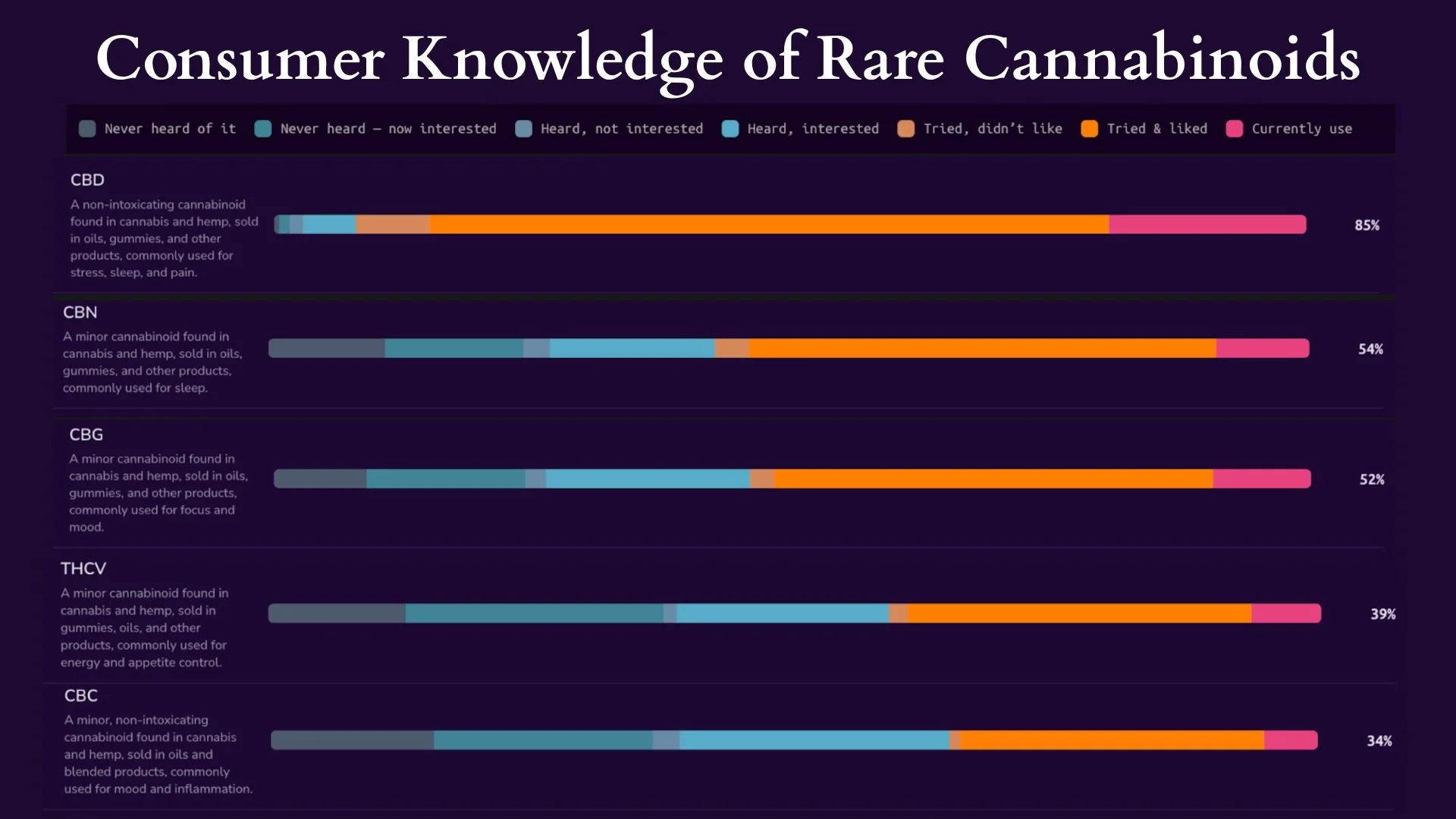
The Real Data Project is a collaboration between the Network of Applied Pharmacognosy (NAP) and MoreBetter Ltd. that brings real world data directly to the participants. Preliminary data from the first wave of an assessment of consumer knowledge (n=392 participants) showed that in comparison to cannabidiol, or CBD, the other four rare cannabinoids CBN, CBG, THCV, and CBC were still not on the radar of most consumers. For each of these cannabinoids, people were asked whether they had heard of the product, ever tried it, and if they tried it, if they liked the experience.
It’s no surprise that most consumers have at least heard of CBD - 98% of people! Out of that 98%, 92% had tried it at least once and 85% said that they liked it. This is what makes CBD such a viable entry option for introducing people into non-intoxicating cannabinoids.
But the next two most commonly heard of cannabinoids CBN and CBG both came in at only 76% of people who had heard of it. And only 57% and 54% of participants had tried CBN or CBG, respectively. However most of the participants who had tried CBN and CBG also enjoyed them; 54% of participants reported enjoying CBN and 52% reported enjoying CBD, which indicates that the hurdle is getting people to commit to trying them.
THCV is structurally very similar to the main psychoactive cannabinoid, THC, but has a completely different effects profile. Only 63% of participants had ever heard of THCV and only 41% of participants had tried them. However, 39% of participants reported liking THCV, so only a very small number of people who tried it don’t like it.
Lastly, CBC is the least known of all of the rare cannabinoids surveyed. While it was similar to THCV in the number of people who had heard of it, coming in at 64%, only 35% of people had tried it. But 34% of participants said they liked CBC, which means almost everyone who tried it, liked it.
This data points to awareness and access as the two biggest bottlenecks for rare cannabinoids despite most people liking products that they try. The gap between awareness and eventually approval and use suggests that these products are effective for the desired purposes once people are able to give them a try. If you’ve only ever tried CBD, you might be missing out on cannabinoids that can be used alone or in combination that many other people are getting great experiences from.
What Benefits Are We Seeking? What Are We Consuming?
A majority of participants were turning to cannabis or cannabinoid products for relaxation or stress relief (77%). Pain and inflammation came in second with 52% of participants reporting it as the primary reason for exploring natural medicines. Sleep and anxiety came in next at 44% and 36%, respectively. Additionally, 64% of participants reported cutting back on alcohol thanks to cannabis products!
Participants’ cannabis use ranged from rarely using cannabis with 22% of participants consuming only once or twice per week or less, to regular consumers with 35% of participants reporting consuming cannabis every day. This was fairly evenly distributed, which means that this data represents many different types of cannabis consumers.
This is just the first wave of insights from the Functional Consumer Insights study piece of the Real Data Project. Whether you’ve tried all five of these cannabinoids or none of them, particiapting helps us to understand what the real research priorities and needs of the community are. If you’re interested in participating in the Real Data Project, click here to sign up for the study and join the real world data exchange platform!