
Beginner’s Guide to Pharmacokinetics
Ever wonder what actually happens to a drug after it has entered your body? Well there’s an entire scientific discipline dedicated to this process known as pharmacokinetics (PK), and the field is growing rapidly.
Before discussing the details of PK, we should examine why it's important to even study it in the first place. Oftentimes, PK indicates what the timing of the drug will be like. It can help us answer anticipatory questions such as “How long until this gummy kicks in?” or “How long until the effects of this capsule wear off?”. Without concrete data from human and animal trials, these questions simply could not be answered. While we cannot make claims about how a drug experience will last with exact certainty or 100% accuracy, we can use PK data to make educated, evidence-based predictions to answer these questions and more.
So, what exactly is PK and how do we measure it? PK is the study of how the body interacts with a drug, and is commonly characterized by 4 processes: absorption, distribution, metabolism, and excretion/ elimination (ADME).
A- Absorption refers to the transportation of the drug to the site of administration.
D- Distribution is defined as the transfer of the drug from one location in the body to the another.
M- Metabolism is known as the process by which the body makes chemical alterations to the drug at the molecular level.
E- Excretion/ elimination is the final step, during which the irreversible removal of the drug from the body takes place.
We can use data from biological specimens, such as blood, saliva, or urine to create a map of the drug’s journey throughout the body and its mechanical breakdown through the ADME process.
This “map” is also known as a PK profile, and every individual drug molecule has its own unique one. Similarly, every individual has their own unique metabolism and way of processing drugs based on their genetics and other factors. PK profiles are typically set up with concentration on the Y-axis and time on the X-axis. This illustrates the change in concentration of a given drug in the body over a period of time, which can tell us several things:
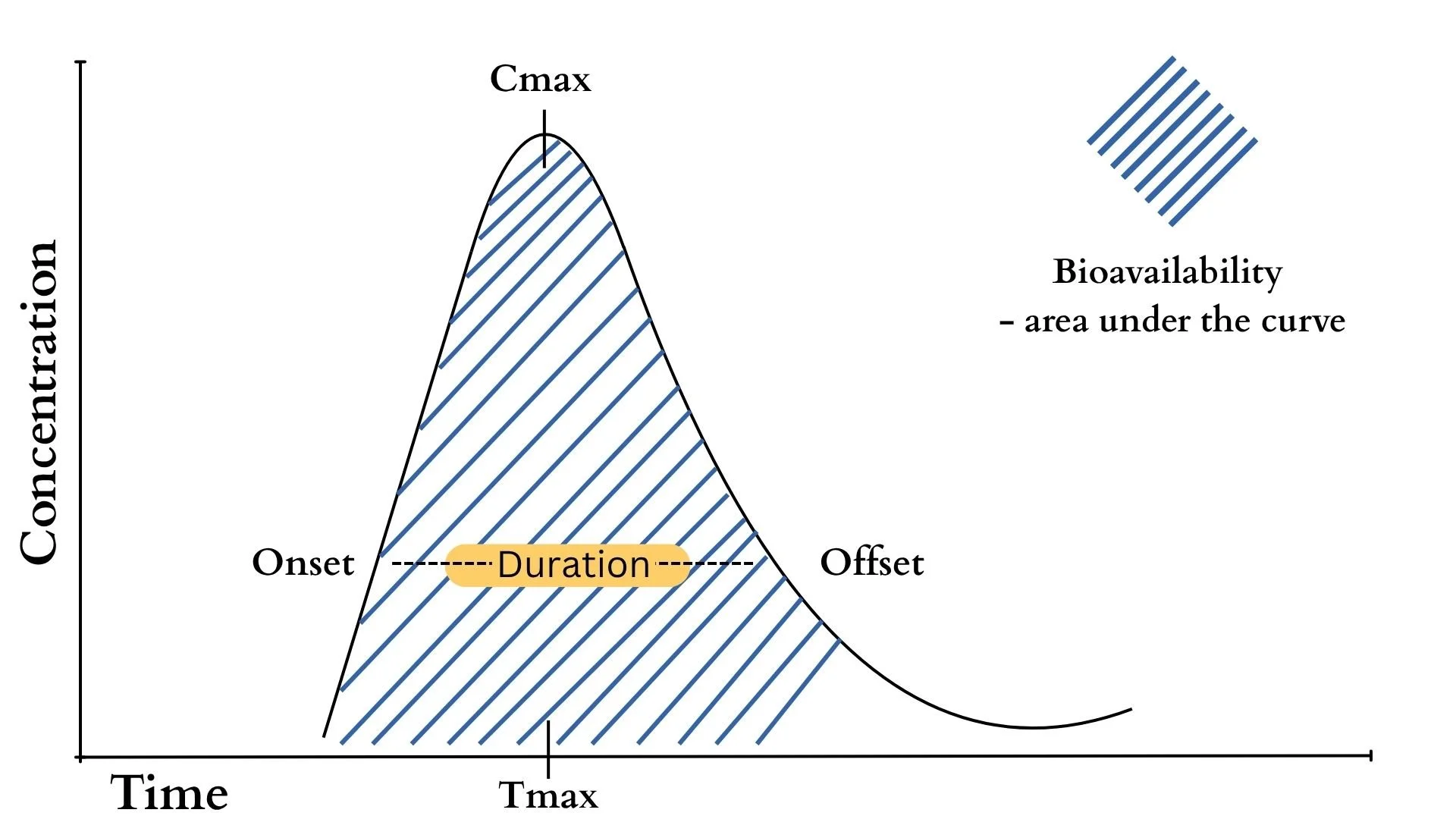
Theoretical PK profile showing how to determine duration, onset, offset, concentration max, time max, and bioavailbility from the image.
Onset: The rate at which the amount of drug in circulation increases
Tmax: What time the concentration may peak
Cmax: The highest concentration of the drug in circulation
Duration: How long the drug remains at a high concentration
Offset: The rate at which the amount of drug in circulation decreases
Bioavailability: The amount of drug that is readily available to enter systemic circulation (This is directly indicated by the Area Under Curve (AUC) on a PK profile!)
So how do we make a PK profile to begin with? And what can we use it for after that? Measuring PK in humans is usually done by collecting blood or other types of biological samples at different points in time before and after an individual has consumed a drug. For example, in a cannabis study, when looking to establish a PK profile for edible products, a researcher might:
Take a blood sample before the participant consumes any cannabis (known as a baseline sample)
Direct the research participant to consume the edible
Take a blood sample again 30 minutes after consumption
Continue taking blood every half hour until it's been 6 hours
After this process, the researcher could then analyze the blood for traces of THC, the primary psychoactive component of cannabis, and map the measured concentration values for each of the samples over the time that they were taken.
After they’ve done this with multiple research participants, averaging the results would produce a representative PK profile for THC in the sample population, which could indicate other details about the experience of the drug. For example, if an individual notices a very sharp increase in the circulatory concentration of a drug based on a PK profile only, they could also hypothesize that the same drug may elicit a sharp increase in psychoactive effects. This is because oftentimes PK correlates to subjective drug effects, though not always with 100% accuracy.
As the world of psychoactive drug research continues to expand, we will be able to establish more accurate PK profiles for a wider variety of substances across a more diverse pool of populations. This will better prepare us for what will happen when these products are actually administered or popularized in society, contributing to both their safety and therapeutic profiles. The next time you consume a drug, whether it's smoking cannabis or taking a Tylenol, remember that the drug compounds within every product take their own unique journey throughout the body over the ADME process, and a researcher somewhere has mapped that journey on a PK profile.