
What Is a “Normal” Dab Size? Real World Data from The Morning Melt - NECANN 2026
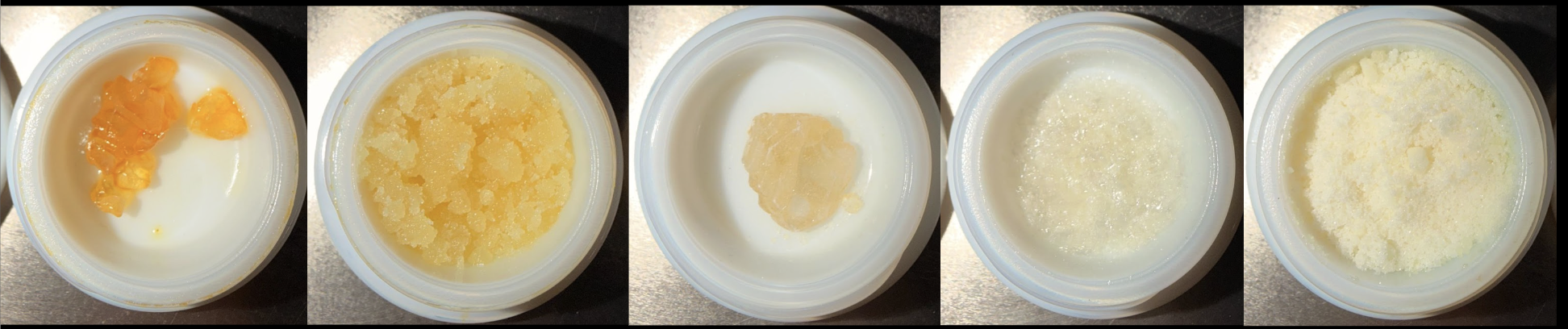
Image description: Isolates and extracts*
In academic cannabis research, concentrates are typically discussed in terms of potency, and much less is known about what a “typical” dab actually looks like in real-world use, especially given the variety of concentrate types available. This past April at NECANN, the Network of Applied Pharmacognosy partnered with Kate Avruch of Operator Academy to collect a small set of real-world dab-dosing data. Attendees at a dab-focused event were asked to portion out what they considered a normal dab, and each sample was weighed. Concentrates, rosin and butane hash oil (BHO), were generously donated by Jar Cannabis Co (ME), Cape Cod Grow Lab (MA), Harbor House Collective (MA), and Lunar Xtracts (MA).
In this sample (n=24), the dabs ranged from 30 mg to 560 mg. A majority of dabs were clustered from 100–150 mg and 250–300 mg. While it’s not enough to prove there are two clear dosing groups, it’s an interesting pattern worth further investigation. The spread also makes sense when you think about the participants at the event. This was a dab-specific crowd, so people were likely coming in with different levels of concentrate experience. For one person, a smaller dab may be enough. For another, especially someone who dabs often, a much larger dab may feel normal. That is why a “normal dab” is hard to pin down from weight alone.
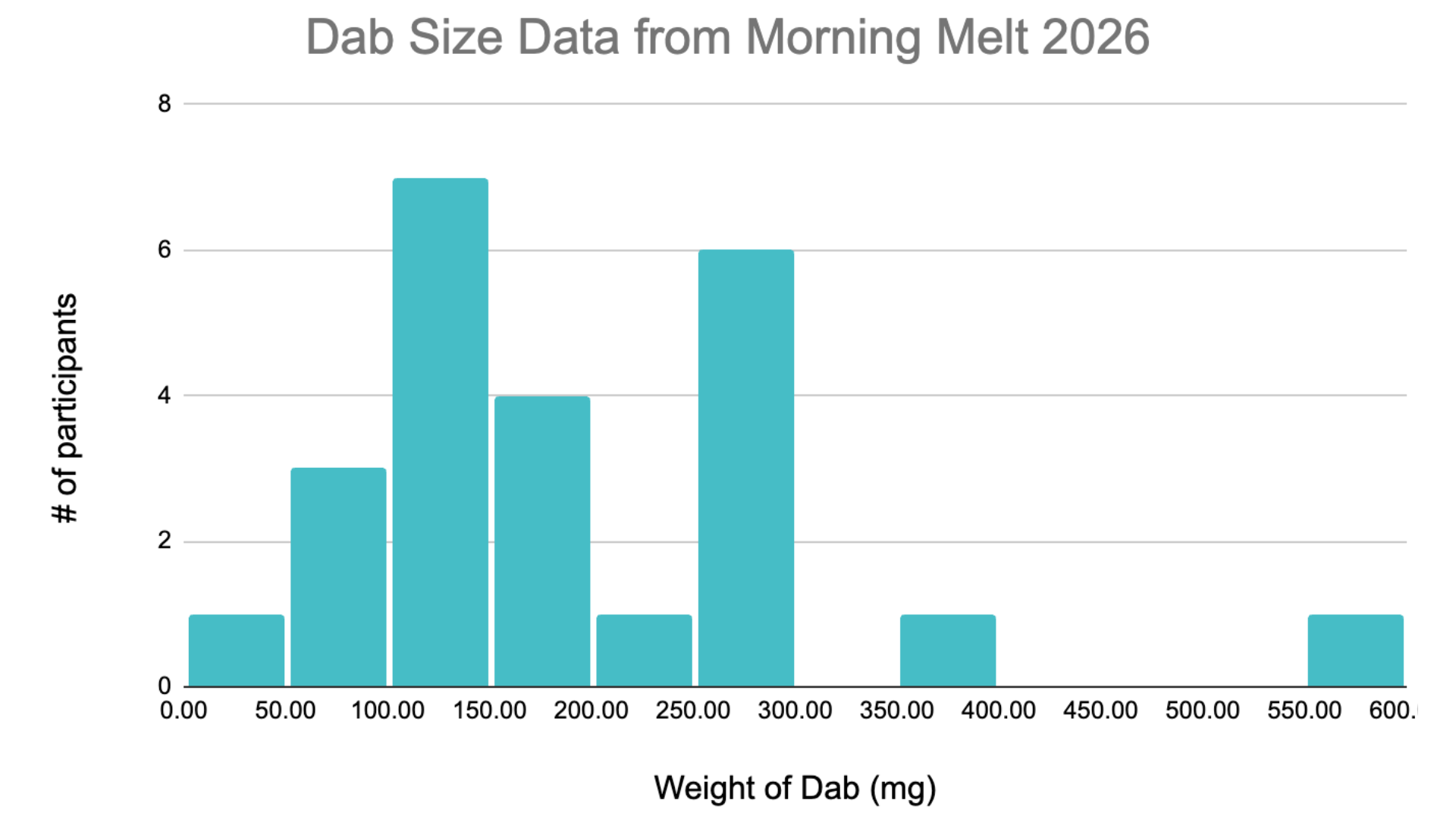
A histogram showing the distribution of dab weights (mg) among the participants during the Morning Melt
The average dab was 183.75mg with a standard deviation of 115mg. The standard deviation shows how different each participant was from each other, and this group showed a high standard deviation, which also shows why the average only tells part of the story. If future data continue to show lower- and higher-dose ranges, it may be more useful to discuss different dosing patterns rather than trying to define a single typical dab size.
Visual dosing makes this even more complicated. A majority of consumers do not weigh their dabs and instead rely purely on visual judgment of size when choosing their dab dose. Concentrates do not all look or move the same way. A saucy live resin spreads differently than a crumbly wax or a dense piece of rosin or THCA diamond. Some products look bigger than they are. Others stay compact and look smaller than they are. So while “start with a rice-sized dab” can be helpful advice, it is not perfect. A rice-sized dab of one product may not weigh the same as a rice-sized dab of another, because concentrates have different consistencies and densities, resulting in the same measured volume having potentially different masses depending on the concentrate type.
The type of device an individual is using is another contributing factor. A dab size that feels normal for a traditional rig may not be the same amount someone would choose for an electronic device. Temperature, banger style, leftover residue, and the overall feel of the session can all affect how much concentrate someone uses.
Since only 24 dabs were measured, it is not enough to say what a “normal” dab is for everyone. It’s better to read it as an early snapshot from a dab-focused event. Still, that snapshot is useful because most dab sizing happens without a scale. People usually go by sight, routine, tolerance, and whatever amount feels familiar. The event was full of experienced concentrate consumers, so the results may not reflect the average cannabis consumer. Future studies should focus on collecting more information about concentrate type, device type, potency, tolerance, and whether people are using cannabis for medical, adult-use, or mixed reasons. Early longitudinal data from the group suggest medical-intention consumers may be more likely to dab on a given day, which could become an important piece of the dosing story as more data are collected.
This NECANN dataset gives us a useful starting point for now. A “normal dab” is not one fixed amount. It changes with the person, the product, the device, and the setting. The most important takeaway for cannabis education: concentrate dosing needs more context than a simple visual estimate can provide. Future studies are needed to build a clearer picture of real-world concentrate dosing so cannabis research and education can move toward guidance that better reflects how people actually use these products.
More About Operator Academy:
Operator Academy is a cannabis workforce training and operations consultancy dedicated to building the next generation of leaders in cannabis manufacturing and science. Through both in-person experiences and virtual education, Operator Academy works with operators, subject matter experts, and industry professionals to translate complex concepts into practical, accessible knowledge. The Morning Melt, Operator Academy's annual pre-NECANN Boston networking event, provided the setting for this real-world concentrate dosing study, bringing together experienced industry professionals in an intimate, hands-on environment where meaningful data collection and genuine industry dialogue can happen side by side.
*isolates and extracts by Murphy Murri