
Different Edibles, Different Effects: How New Nano-emulsified Products are Absorbed and Metabolized Differently
Ever had a completely different experience with a cannabis drink and a cannabis brownie? Scientists think that there may be a reason and are working to better understand why.
An ongoing study at Johns Hopkins Cannabis Science Lab is investigating how different edible formulations may influence the way THC (the main psychoactive component in cannabis) is absorbed and metabolized in the body. This study goes beyond THC potency or dose, as it asks the question: Does the way a product is made change how it works in the body? Let’s dive into the background of the study!
Cannabis has many sources of complexity, one being variation between routes of administration (how cannabis gets into the body). Smoking, vaping, and eating cannabis all produce different onsets and intensities of effects. Edibles are especially complex because unlike inhaled cannabis, which enters the bloodstream rapidly through the lungs, edibles must pass through the digestive system and liver before entering blood circulation. This process creates additional variability such as delayed onset and unpredictable absorption in the bloodstream.
To add more complexity, edibles differ by formulation (what components make up the product). New variations of edibles are becoming widely available due to their popularity and accessibility, but research is still catching up. Despite 38 states having legalized medicinal cannabis, there are still barriers to being able to research even the most commonly consumed products. Understanding the origins of these complexities can help us minimize the risk of adverse or unpredictable effects. How might all of these product formulations impact the consumer, even at the same dose (total mg of THC)?
Let’s consider the 3 most common formulations for making edibles: high-fat, low-fat, and nanoemulsion.
High-fat edibles are typically baked goods like brownies or cookies, typically made with a cannabis-infused butter or oil. Because THC is a fat-soluble molecule, it dissolves well in these mediums. These were the only edibles available for a very long time prior to the more recent advances in the industry.
Low-fat edibles are products such as gummies and candies that deliver THC via a gelling agent (gelatin or pectin) rather than fat.
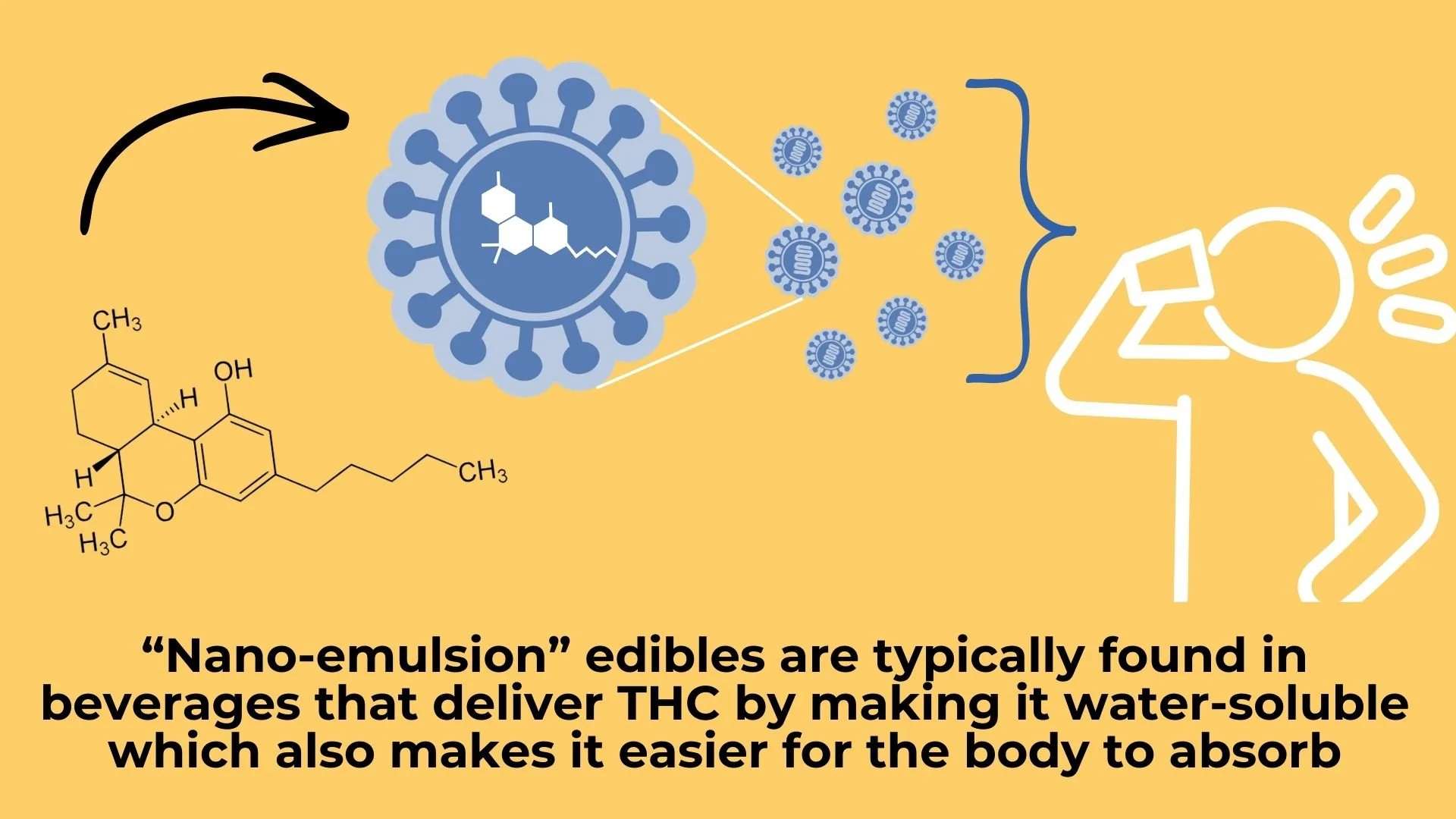
“Nano-emulsion” is typically used to produce beverages that deliver THC by making it water-soluble.
THC is a fatty molecule that is usually not soluble in water. However, through the chemical process of “nano-emulsion”, which reduces the size of particles down to the nano-scale, cannabinoids can act water-soluble and be dispensed in beverages! While the study at JH is ongoing, scientists predict that formulation might matter in terms of a) how available the active ingredient (THC) is once in the body and b) how rapidly the drug is absorbed into the body between each type of formulation.
As we’ve mentioned, THC is a fat-soluble molecule, meaning it dissolves more easily in fat than in water. Based on this characteristic, we can hypothesize that fat content may influence how THC is processed in the digestive system. Additionally, particle size may influence how quickly THC moves from the gut into the bloodstream, which is important to consider in the nano-emulsion formulation. Different edible formulations might alter how much THC ultimately becomes biologically available.
These hypotheses are currently being investigated and it is important to understand why they could matter for the consumer. Two products in a dispensary could contain the same labeled dose but differ in ingredients, fat content, and THC particle size. For example, both could say 10 mg of THC, but they each deliver those 10 mg via a different vehicle. Researchers are working to determine whether those differences meaningfully impact absorption, metabolism, and subjective effects.
These results are important to consider in medical and recreational settings. Understanding how formulation influences drug delivery could help improve customer education, inform medical guidance, support evidence-based regulatory standards, and reduce the risk of adverse experiences. Better data may eventually allow clinicians , regulators, and consumers to make more informed decisions about edible cannabis products.
So, next time you consider picking up an edible or sharing one with a friend, consider how its make up could influence how quickly it will impact you and how long you will feel the effects in order to be prepared for your experience and avoid any unexpected outcomes. Ask yourself if it’s more of a gummy moment, or more of a drink moment!
—————————————-
Disclosures: This research is funded by the National Institute of Health (NIH) under Grant Number 5R01DA057201. This study is led by Dr. Tory Spindle, Principal Investigator at Johns Hopkins Cannabis Science Lab. You can learn more here: https://reporter.nih.gov/search/QqljKYRVSEqkLPDruix6sw/project-details/10873795.