
Synthetic, Alternative, Rare? Different cannabinoids and where they come from.
When you consider the word “"cannabinoid,”" the first thought is usually something relating to cannabis. In fact, some might say that cannabinoids, in addition to hundreds of other chemical components, are what make cannabis, well, cannabis! With the ever-expanding cannabis industry, including specialties such as cannabinoid isolation, processing, and cultivation; members of the community are witnessing the introductions of many new alternative, rare, synthetic, and semisynthetic cannabinoids.
What do these classifications mean? Where are these compounds coming from? Are they from the cannabis plant, or made from something completely different?
These are the questions we will dive into and discuss in this blog!
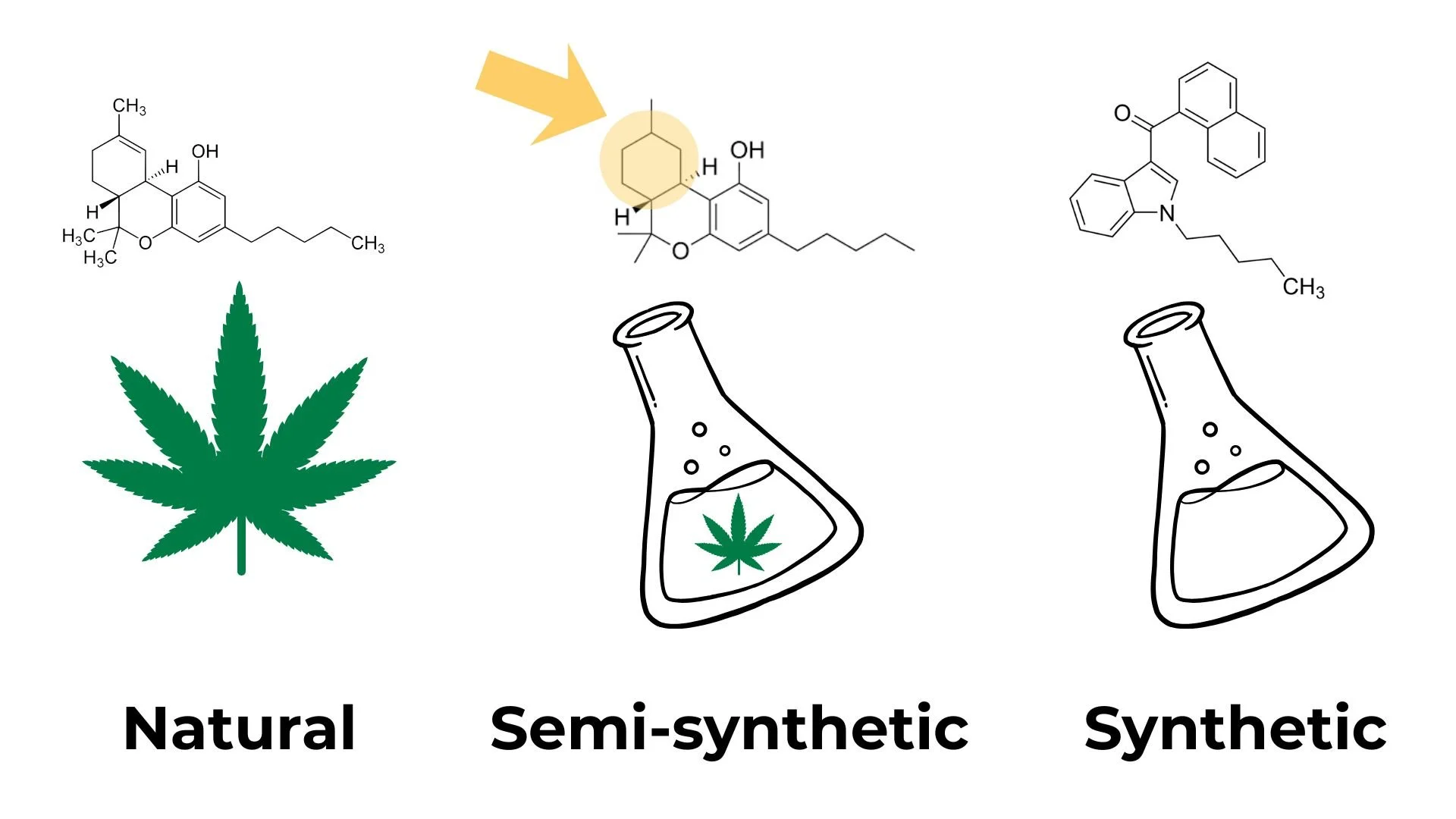
Natural, Synthetic, Semisynthetic, What’s the Difference?
Natural chemical components are described as originating from sources such as plants, animals or minerals. Real world examples for each of these natural component types could include things like tomatoes, pork products, or quartz crystals. For cannabis, this could be any of the over 400 different natural chemical components that exist within the plant.
On the opposite side of things, synthetic chemical components are compounds created from non-natural sources in a controlled environment such as a laboratory. A few examples of non-cannabis synthetic compounds are those found in plastics, lab grown diamonds, or even artificial sweeteners like aspartame. Whether a cannabinoid is synthetically or naturally derived, it is important to learn the differences between these two terms and how they are applied to cannabis.
When considering cannabinoids, many of them are naturally found within the cannabis plant. This includes the most abundant cannabinoid, delta-9-THC. However, there are cases of synthetically produced delta-9-THC, such as that found in the prescription drug Dronabinol. This drug is a synthetic version of delta-9-THC, synthesized — meaning the final product starts as two or more different products! You can find other examples of synthetically produced cannabinoids in the research studies of Nguyen et. al, (2022) and Yan et. al, (2025).
In some cases the starting material did not originate from non-naturally occurring sources, they originated from biological sources. These then bring the classification ‘semisynthetic’ to the conversation. Semisynthetic is directly defined as, “produced by chemical alteration of a natural starting material.” In other words, beginning with a natural source, a chemical process is then carried out, resulting in the desired final product, a semisynthetic substance. Some semisynthetic substances you may encounter are cotton candy, plant-based meat alternatives, or LSD.
Researchers have tried using a common fungus to synthesize rare cannabinoids such as THCPA (tetrahydrocannabiphorolic acid) and THCCA (tetrahydrocannabiorcolic acid) (Yan, et. al, 2025). This attempt was unsuccessful, however, they were able to synthesize these cannabinoids from Brewer’s yeast (Yan, et. al, 2025). This example highlights the ability to utilize biological components in chemical synthesis, however, this is not semisynthesis. If we modified the processes carried out by Yan, et. al, (2025), we could in theory make this a semisynthetic procedure. To do this, we would start with a yeast, fungus, or other living organism. We would then feed the organism a natural starting material and wait for the chemically changed semisynthetic product to become available for extraction.
THCP, HHC, and Delta-8 (Psychoactive and Semisynthetic)
Now you may be curious, if there are so many different natural chemicals in the cannabis plant, what categories would unnatural cannabinoids fall into?
Since many rare cannabinoids, such as THCV or CBN, can only be found in trace amounts within cannabis plant material, the production of many rare cannabinoids has become semisynthetic. This is because traditional extraction and isolation methods are not feasible due to the low or non-existent concentrations of these compounds in the starting material - cannabis flower!
In cases of cannabinoids such as THCP (tetrahydrocannabiphorol), HHC (hexahydrocannabinol), or Delta-8-THC, the process usually begins by obtaining naturally extracted cannabinoids, and then chemically altering them. This classifies them as semisynthetic. Natural cannabinoids include CBD, CBGA (cannabigerolic acid), Delta-9-THC, and many others; all that are relatively abundant in dried cannabis flower.
This synthetic process is used to produce larger amounts of Delta-8-THC. This starts with an isolate (single ingredient) sample of CBD or Delta-9-THC. From here, a chemical process termed isomerization is enacted on the compounds using chemicals such as solvents and acids (Gieringer, 2025). This results in the production of Delta-8-THC. This process can also be applied to the synthesis of other cannabinoids such as previously mentioned THCP and HHC, both of which are derived from CBD isolate.
CBG, CBN, and CBC (Therapeutic and Rare)
Semi synthesis is not just tied to psychoactive cannabinoids; it is also applied to minor non-psychoactive cannabinoids. Three up and coming rare cannabinoids being produced for their potential therapeutic effects are CBG (cannabigerol), CBN (cannabinol), and CBC (cannabichromene). These three cannabinoids are specifically of interest due to their increased popularity in both legal and non-legal cannabis states.
These cannabinoids are found in the cannabis plant at higher concentrations than the aforementioned rare psychoactive cannabinoids. However, these percentages are still not high enough to keep up with the demand for these compounds. In some cases, these compounds are being synthesized or semi synthesized in a lab setting.
The importance and full effects of these cannabinoids are not yet widely known. However, some possible effects that have been reported are decreased anxiety, increased mood control, and even decreased symptoms of depression (Grinspoon, 2022).
As we continue to discover more rare, minor cannabinoids, and other compounds of the cannabis plant, we must remember to put consumer safety at the forefront of concern. If the cannabinoids require dangerous synthesis procedures to be produced in large quantities, we must first consider the impact this may have on the general public and producers. Creating resources like the one above is just one of the many small steps that are needed for keeping consumers educated.
REFERENCES
Anderson, E., & Zagorski, J. (2025, May 5). What’s the risk? Synthetic vs natural chemical ingredients. Center for Research on Ingredient Safety. https://cris.msu.edu/news/whats-the-risk/whats-the-risk-synthetic-vs-natural-chemical-ingredients/
Gieringer, D. (n.d.). NORML’s Guide to Delta-8 THC and Other Novel Cannabinoids. NORML. https://norml.org/marijuana/fact-sheets/normls-guide-to-delta-8-and-other-novel-cannabinoids/
Grinspoon, P. (2021, March 23). Beyond CBD: Here come the other cannabinoids, but where’s the evidence? Harvard Health. https://www.health.harvard.edu/blog/beyond-cbd-here-come-the-other-cannabinoids-but-wheres-the-evidence-2021032322190
Nguyen, G.-N., Jordan, E. N., & Kayser, O. (2022). Synthetic Strategies for Rare Cannabinoids Derived from Cannabis sativa. Journal of Natural Products, 85(6), 1555–1568. https://doi.org/10.1021/acs.jnatprod.2c00155
Yan, C., Okorafor, I. C., Johnson, C. W., Houk, K. N., Garg, N. K., & Tang, Y. (2025). Microbial Biosynthesis of Rare Cannabinoids. Journal of Industrial Microbiology & Biotechnology, 52. https://doi.org/10.1093/jimb/kuaf013