
Introducing NAP’s Inaugural Science Communication Team!
The Network of Applied Phamacognosy (NAP) and the University of Maryland School of Pharmacy Medical Cannabis Science and Therapeutics Program have launched a Natural Products Science Communication Internship reflecting our shared mission of advancing inclusive and community-centered science advocacy in the cannabis space. Our inaugural class of budding science communicators all share a passion for increasing public awareness around cannabis from the patient and consumer’s perspectives. We’re thrilled to be amplifying and advising them as they find their voices and hone their messaging.
The University of Maryland School of Pharmacy is the nation’s first master’s program in medical cannabis science! They also offer a graduate certificate program and blends online instruction with face-to-face experiences at at the Universities at Shady Grove in Rockville, Md. We are very excited to have a group of talented students contributing to NAP’s science communication through our social media and blog!
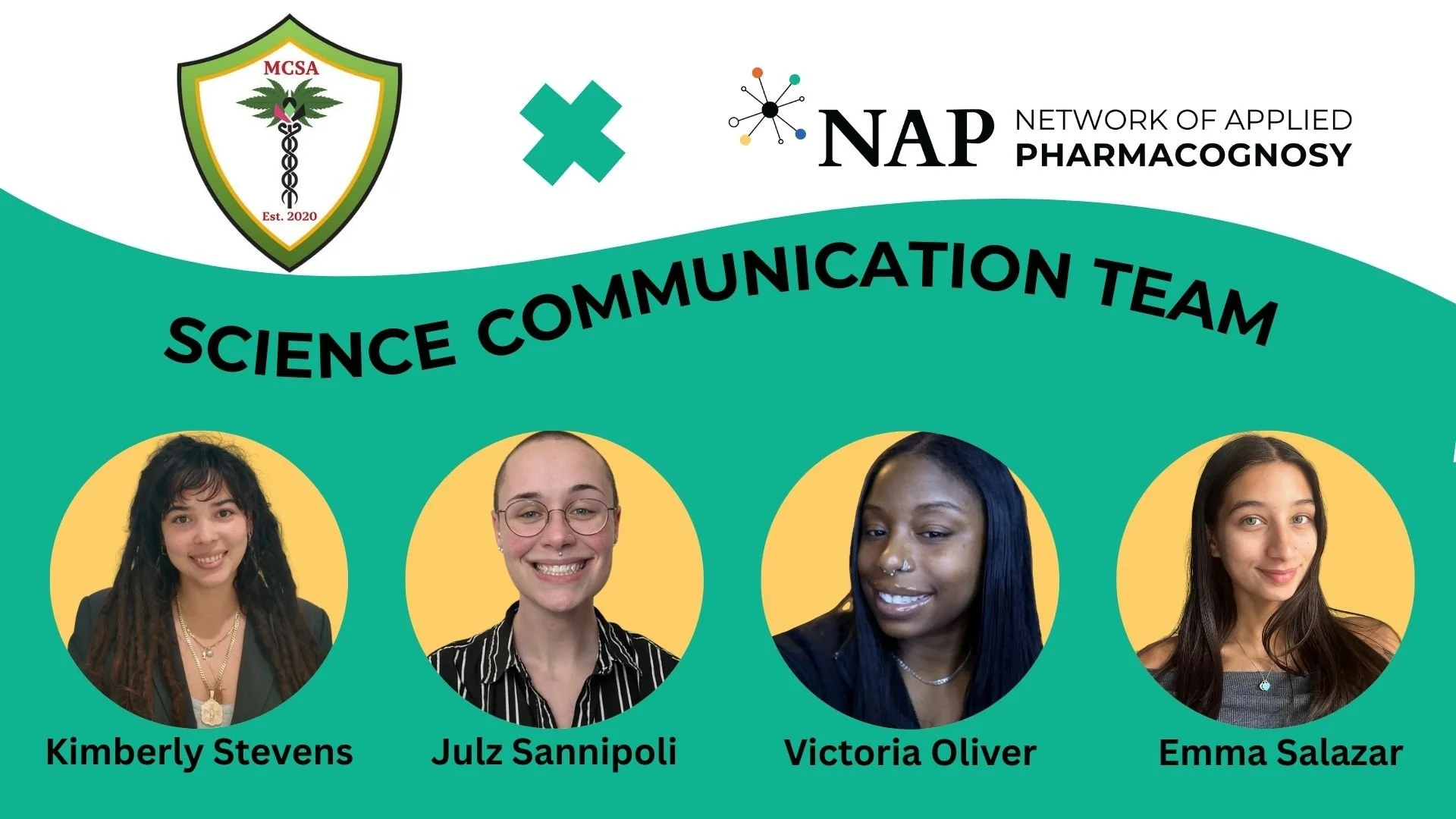
Kimberly Stevens is a digital creator with a background in Public Health who will be helping with our social media content and page management of our Instagram. She’s interested in breaking down complex research topics into simple, intuitive, and relatable graphics and campaigns that everyone can understand. She says, “science progress matters to everyone, not just the experts. Accessible information creates curiosity, informed decision making, and trust.” She’s personally interested in the chemical diversity in cannabis, or how terpenes, other aroma molecules, and other active components of cannabis combine to create unique effects. Follow Kim at: @kimcaryophyllene
Victoria Oliver comes from a background in health sciences and will be creating content for our social media and contributing to page management of our LinkedIn. Victoria wants to contribute to public education to improve individual empowerment of consumers, fight misinformation and historical biases, and aid in policy reforms that will accelerate impactful research. She says, “communication of science plays a vital role in providing a bridge between gaps in research and the lack of knowledge among individuals in society.” She’s also a cultivator and her research interests span from optimizing cultivation to optimizing dose and formulations for specific people.
Julz Sannipoli brings a unique perspective as an intersectional medical advocate from a non-legalized state who is dedicating her life to accessible cannabis education combined with advocacy and innovation. Julz will be writing and editing blog articles covering not only NAP’s research updates, but other topics of interest, starting with the synthetic and semi-synthetic cannabinoids. She says “If we can create accessible narratives for scientific evidence, then we can hope to generate forms of communication that are available to everyone.” Follow Julz: www.linkedin.com/in/julz-sannipoli
Emma Salazar is a cannabis researcher at Johns Hopkins who will be writing and editing blog articles covering not just her research topics of interest, but other valuable research that is misconstrued in the media. She says, “access to information is a privilege [...] If research cannot be translated into language that the general public cannot understand, it is far less useful. Drug science, as it pertains to public health, public safety, and medicine is a crucial area of research that the public deserves readable access to.” Emma’s research interests include edible metabolism, polysubstance use, and cannabis and driving. Follow Emma: www.linkedin.com/in/emma-l-salazar
Micheal Kabtimer is passionate about destigmatizing cannabis and using public education and science communication to increase access to cannabis. Micheal will be writing and editing blog articles that communicate complex ideas in a digestible way, and says, “people cannot make informed decisions on things they do not know.” Micheal’s interests include cannabis and COVID-19 and cannabis and hormone replacement therapy (HRT).
The future of science communication can’t be just scientists, but grassroots community advocates. The most impactful conversations often happen over the dinner table, at a bar, or in a living room, not a formal presentation. We are excited to work alongside people who care deeply about our community and want to break the research down into reality.
If you’re passionate about sharing your perspective on cannabis science, policy, or lived experience, we invite you to submit a blog or topic to our team! For more information on the program at University of Maryland, click the button below!